class: middle, center <!--- https://katex.org/docs/supported.html#macros ---> $$ \global\def\myx#1{{\color{green}\mathbf{x}\_{#1}}} $$ $$ \global\def\myxa#1{{\color{green}\mathbf{x}\_{#1}^{(a)}}} $$ $$ \global\def\myza#1{{\color{green}\mathbf{z}\_{#1}^{(a)}}} $$ $$ \global\def\myxv#1{{\color{purple}\mathbf{x}\_{#1}^{(v)}}} $$ $$ \global\def\myzv#1{{\color{purple}\mathbf{z}\_{#1}^{(v)}}} $$ $$ \global\def\myzav#1{{\color{brown}\mathbf{z}\_{#1}^{(av)}}} $$ $$ \global\def\myzds#1{{\color{brown}\mathbf{z}\_{#1}^{(av)}}} $$ $$ \global\def\mywav{{\color{brown}\mathbf{w}^{(av)}}} $$ $$ \global\def\myw{{\color{brown}\mathbf{w}}} $$ $$ \global\def\mys#1{{\color{green}\mathbf{s}\_{#1}}} $$ $$ \global\def\myS#1{{\color{green}\mathbf{S}\_{#1}}} $$ $$ \global\def\myz#1{{\color{brown}\mathbf{z}\_{#1}}} $$ $$ \global\def\myztilde#1{{\color{brown}\tilde{\mathbf{z}}\_{#1}}} $$ $$ \global\def\myhnmf#1{{\color{brown}\mathbf{h}\_{#1}}} $$ $$ \global\def\myztilde#1{{\color{brown}\tilde{\mathbf{z}}\_{#1}}} $$ $$ \global\def\myu#1{\mathbf{u}\_{#1}} $$ $$ \global\def\mya#1{\mathbf{a}\_{#1}} $$ $$ \global\def\myv#1{\mathbf{v}\_{#1}} $$ $$ \global\def\mythetaz{\theta\_\myz{}} $$ $$ \global\def\mythetax{\theta\_\myx{}} $$ $$ \global\def\mythetas{\theta\_\mys{}} $$ $$ \global\def\mythetaa{\theta\_\mya{}} $$ $$ \global\def\bs#1{{\boldsymbol{#1}}} $$ $$ \global\def\diag{\text{diag}} $$ $$ \global\def\mbf{\mathbf} $$ $$ \global\def\myh#1{{\color{purple}\mbf{h}\_{#1}}} $$ $$ \global\def\myhfw#1{{\color{purple}\overrightarrow{\mbf{h}}\_{#1}}} $$ $$ \global\def\myhbw#1{{\color{purple}\overleftarrow{\mbf{h}}\_{#1}}} $$ $$ \global\def\myg#1{{\color{purple}\mbf{g}\_{#1}}} $$ $$ \global\def\mygfw#1{{\color{purple}\overrightarrow{\mbf{g}}\_{#1}}} $$ $$ \global\def\mygbw#1{{\color{purple}\overleftarrow{\mbf{g}}\_{#1}}} $$ $$ \global\def\neq{\mathrel{\char`≠}} $$ .big-vspace[ ] # A quick overview of the variational autoencoder, downstream tasks and extensions .vspace[ ] .center[Simon Leglaive] .small.center[CentraleSupélec, IETR (UMR CNRS 6164), France] .big-vspace[ ] .center.width-7[] .grid[ .kol-1-6[ .left.width-120[] ] .kol-2-3[ .small.center[IMAGE department seminar - November 18, 2025] ] .kol-1-6[ .right.width-65[]] ] --- class: middle, center count: false # The variational autoencoder --- class: middle ## Low-dimensional modeling of high-dimensional structured data .center.width-90[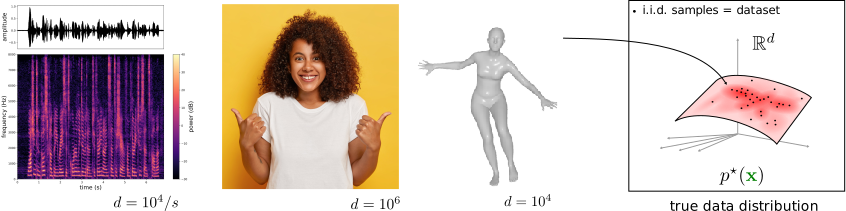] **High-dimensional data** $\myx{} \in \mathbb{R}^d$ such as 3D human meshes, natural images, or speech signals exhibit some form of **structure**, preventing their dimensions from varying independently. - From a **geometric perspective**, this regularity suggests that the high-dimensional data actually live in a much lower-dimensional manifold. - From a **generative perspective**, it suggests that there exists a smaller dimensional **latent variable** $\myz{} \in \mathbb{R}^\ell$ that generated $\myx{} \in \mathbb{R}^d$, $\ell \ll d$. .credit[Picture credits: <a href="https://fr.freepik.com/photos-gratuite/heureuse-fille-aux-cheveux-boucles-fait-signe-pouce-air-demontre-son-soutien-son-respect-quelqu-sourit-agreablement-atteint-objectif-souhaitable-porte-t-shirt-blanc-isole-mur-jaune_11932454.htm#query=black%20woman%20face&position=2&from_view=search">wayhomestudio</a> on Freepik. ] --- class: middle ## Latent-variable generative modeling .small-vspace[ ] .center.width-90[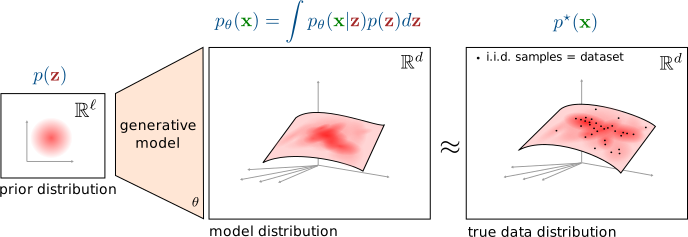] <!-- $$ \hspace{1cm} \underbrace{p\_\theta(\myx{}) = \int p\_\theta(\myx{} |\myz{}) p(\myz{}) d\myz{}}\_{\text{model distribution}} \hspace{.25cm} \approx \hspace{-.5cm} \underbrace{\vphantom{\int}p^{\star}(\myx{})}\_{\text{true data distribution}} $$ --> - Generative modeling consists of estimating the parameters $\theta$ so that $p\_\theta(\myx{}) \approx p^\star(\myx{})$ according to some measure of fit, for instance the Kullback-Leibler (KL) divergence. - When the model includes a deep neural network, we obtain a **deep generative model**. --- class: middle .nvspace[ ] ## The variational autoencoder (VAE) .tiny[(Kingma and Welling, 2014; Rezende et. al., 2014)] .grid[ .kol-1-2[ - .underline[Prior]: $\qquad p(\myz{}) = \mathcal{N}(\myz{}; \mathbf{0}, \mathbf{I})$ - .underline[Generative model]: $ p\_\theta(\myx{} | \myz{}) = \mathcal{N}\left( \myx{}; \boldsymbol{\mu}\_\theta(\myz{}), \boldsymbol{\Sigma}\_\theta(\myz{}) \right) $ .small[where] $\small \boldsymbol{\mu}\_\theta(\myz{}), \boldsymbol{\Sigma}\_\theta(\myz{})$ .small[are the outputs of the **decoder**.] - .underline[Inference model]: $ q\_\phi(\myz{} | \myx{}) = \mathcal{N}\left( \myz{}; \boldsymbol{\mu}\_\phi(\myx{}), \boldsymbol{\Sigma}\_\phi(\myx{}) \right) \\\\$ .small[where] $\small \boldsymbol{\mu}\_\phi(\myx{}), \boldsymbol{\Sigma}\_\phi(\myx{})$ .small[are the outputs of the **encoder**.] ] .kol-1-2[ .vspace[ ] .center.width-90[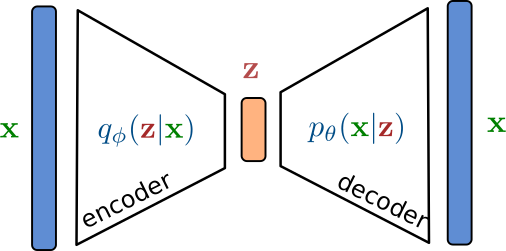] ] ] The **model is trained without supervision**, inspiring from variational Bayesian inference techniques .small[(Jordan et al. 1999)]. .small-nvspace[ ] .credit[ .vpsace[ ] D.P. Kingma and M. Welling (2014). Auto-encoding variational Bayes. ICLR. <br> D.J. Rezende, S. Mohamed, D. Wierstra, (2014).Stochastic backpropagation and approximate inference in deep generative models. ICML. <br> M.I. Jordan, Z. Ghahramani, T.S. Jaakkola, L.K. Saul (1999). An introduction to variational methods for graphical models. Machine Learning. 1999. ] --- ## One model, many tasks We can use a pre-trained VAE for several different tasks. .width-80[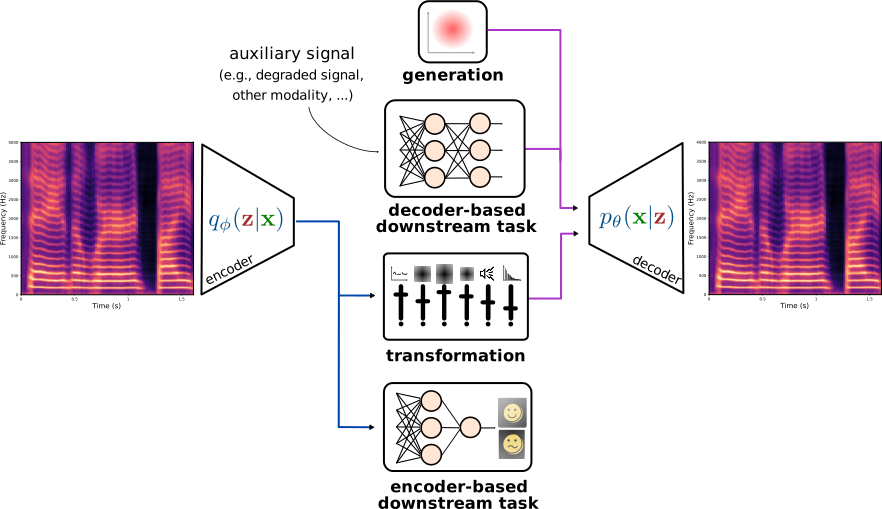] <div style="position:absolute; bottom:0rem; right:1rem; width:300px;"> <img src="images/bonhomme_dpt_image.svg" style="width:100%; height:auto;"> </div> --- ## Generation task How to generate new data samples? .center.width-80[] --- ## Decoder-based downstream task How to infer the latent variables given auxiliary signals? .center.width-80[] --- ## Transformation task How to disentangle, interpret, and control the latent representation? .center.width-80[] .credit[I. Higgins, D. Amos, D. Pfau, S. Racaniere, L. Matthey, D. Rezende, A. Lerchner (2018). Towards a definition of disentangled representations. arXiv preprint arXiv:1812.02230.] --- ## Encoder-based downstream task How to build sample-efficient, robust, and generalizable information extraction systems? .center.width-80[] .credit[S. van Steenkiste, F. Locatello, J. Schmidhuber, O. Bachem. Are disentangled representations helpful for abstract visual reasoning?, NeurIPS, 2019.] --- class: middle, center count: false # A rapid tour of downstream tasks based on VAEs --- ### Decoder-based downstream task ### .medium[Unsupervised speech enhancement] .tiny[(Bando et al., 2018; Leglaive et al., 2018)] .small-vspace[ ] .center.width-70[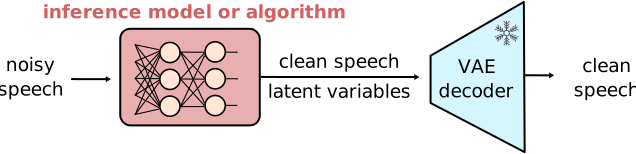] .medium[ - Given a VAE pretrained on clean speech, the speech enhancement task consists of **inferring the VAE latent variables given a noisy speech recording**. - Approximate posterior inference using Markov chain Monte Carlo .small[(Bando et al., 2018; Leglaive et al., 2018)] or variational inference .small[(Leglaive et al., 2020)]. - Test-time iterative optimization: good in terms of adaptation but slow and performance limited compared to supervised methods on in-domain data. ] .credit[ Y. Bando, M. Mimura, K. Itoyama, K. Yoshii, T. Kawahara (2018). Statistical speech enhancement based on probabilistic integration of variational autoencoder and non-negative matrix factorization. IEEE ICASSP. <br> S. Leglaive, L. Girin, R. Horaud (2018). A variance modeling framework based on variational autoencoders for speech enhancement. IEEE MLSP. <br> S. Leglaive, X. Alameda-Pineda, L. Girin, R. Horaud (2020). A Recurrent Variational Autoencoder for Speech Enhancement. IEEE ICASSP. ] --- .grid[ .kol-1-3.center[ <img src="audio/speech_enhancement/3-0-mix.svg", width=75%> .small-nvspace[ ] <audio controls src="audio/speech_enhancement/3-0-mix.wav"></audio> .center.small[Mixture] ] .kol-1-3.center[ <img src="audio/speech_enhancement/3-0-RVAE-BRNN-VEM.svg", width=75%> .small-nvspace[ ] <audio controls src="audio/speech_enhancement/3-0-RVAE-BRNN-VEM.wav"></audio> .center.small[RVAE VEM (Leglaive et al., 2020)] ] .kol-1-3.center[ <img src="audio/speech_enhancement/3-0-SEMamba-VB-DMD.svg", width=71%> .small-nvspace[ ] <audio controls src="audio/speech_enhancement/3-0-SEMamba-VB-DMD.wav"></audio> .center.small[SEMamba (Chao et al., 2024)] ] ] .small-nvspace[ ] .grid[ .kol-1-3.center[ <img src="audio/speech_enhancement/matmatah-mix.svg", width=75%> .small-nvspace[ ] <audio controls src="audio/speech_enhancement/matmatah-mix.wav"></audio> .center.small[Mixture] ] .kol-1-3.center[ <img src="audio/speech_enhancement/matmatah-BRNN-VEM-voice.svg", width=75%> .small-nvspace[ ] <audio controls src="audio/speech_enhancement/matmatah-BRNN-VEM-voice.wav"></audio> .center.small[RVAE VEM (Leglaive et al., 2020)] ] .kol-1-3.center[ <img src="audio/speech_enhancement/matmatah-SEMamba-VB-DMD-voice.svg", width=71%> .small-nvspace[ ] <audio controls src="audio/speech_enhancement/matmatah-SEMamba-VB-DMD-voice.wav"></audio> .center.small[SEMamba (Chao et al., 2024)] ] ] .credit[ R. Chao, W.-H. Cheng, M. La Quatra, S. M. Siniscalchi, C.-H. H. Yang, S.-W. Fu, Y. Tsao (2024). An investigation of incorporating Mamba for speech enhancement. IEEE SLT. <br> https://huggingface.co/spaces/rc19477/Speech_Enhancement_Mamba ] --- ### Decoder-based downstream task ### .medium[Masked generative human mesh recovery (HMR)] .tiny[(Fiche et al., 2025)] .grid[ .kol-1-2[ .width-100[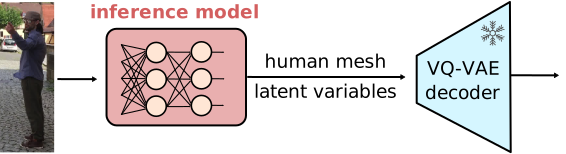] ] .kol-1-2[ .tiny-vspace[ ] <video controls width="100%" loop autoplay muted> <source src="images/MEGA_multi_hor.mp4" type="video/mp4"> </video> ] ] .medium[ - **HMR is an ill-posed problem**: There exists an infinity of 3D human meshes that can explain equally well the 2D observation. - We account for this ambiguity by designing the inference model as a **conditional masked generative model**. - We can obtain the **most likely output** by computing the argmax of the conditional distribution, or generate **multiple plausible outputs** by stochastic sampling. ] .credit[ G. Fiche, S. Leglaive, X. Alameda-Pineda, F. Moreno-Noguer (2025). MEGA: Masked generative autoencoder for human mesh recovery. IEEE/CVF CVPR. ] --- class: middle, center The variance of the predictions can be interpreted as a measure of **uncertainty**. .center.width-100[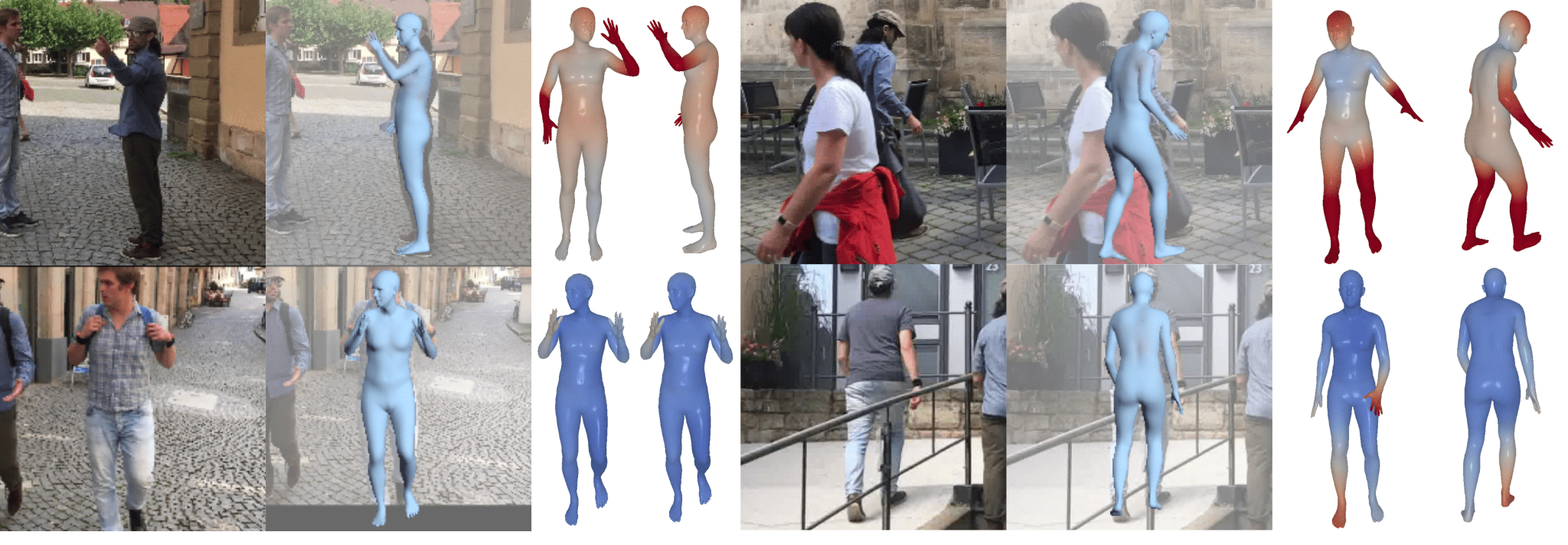] --- ### Transformation downstream task ### .medium[Expressive audiovisual speech processing] .tiny[(Sadok et al., 2024)] .small-nvspace[ ] .grid[ .kol-1-2[ .underline.medium[**Observed** audiovisual speech data:] .medium[ - <font color="#258212">Audio</font>: $\hspace{1cm} \myxa{} \in \mathbb{R}^{d\_a \times T}$ - <font color="#800080">Visual</font>: $\hspace{.98cm} \myxv{} \in \mathbb{R}^{d\_v \times T}$ ] .center[ <video controls width="400"> <source src="videos/W016_happy_level2_004.mp4" type="video/mp4"> </video> ] ] .kol-1-2[ .underline.medium[**Latent** variables:] .medium[ - Static, <font color="brown">audiovisual</font>: $\hspace{1.2cm}\myw \in \mathbb{R}^{\ell\_w}$ <br> .small[(e.g., speaker's identity and global emotional state)] - Dynamical, <font color="brown">audiovisual</font>: $\hspace{.65cm}\myzav{} \in \mathbb{R}^{\ell\_{av} \times T}$ <br> .small[(e.g., lip movements, phonemic information (part of))] - Dynamical, <font color="#800080">visual</font>: $\hspace{1.4cm}\myzv{} \in \mathbb{R}^{\ell\_v \times T}$ <br> .small[(e.g., other facial movements and head pose)] - Dynamical, <font color="#258212">audio</font>: $\hspace{1.45cm}\myza{} \in \mathbb{R}^{\ell\_a \times T}$ <br> .small[(e.g., pitch variations, phonemic information (part of))] ] ] ] We proposed the multimodal dynamical VAE (MDVAE) model to decompose / generate audiovisual speech into / from these latent factors, without supervision. .credit[Video credits: K. Wang et al., MEAD: A large-scale audio-visual dataset for emotional talking-face generation, ECCV, 2020. <br> S. Sadok, S. Leglaive, L. Girin, X. Alameda-Pineda, R. Séguier (2024). A multimodal dynamical variational autoencoder for audiovisual speech representation learning. Neural Networks. ] --- class: middle, center .grid[ .kol-1-2[ We transfer $\myzav{}$ from the central sequence in red to the surrounding sequences. .center[ <video controls width="450" loop autoplay muted> <source src="demo/mosaic/z_av.mp4" type="video/mp4"> </video> ] Lip and jaw movements are transfered. ] .kol-1-2[ We transfer $\myzv{}$ from the central sequence in red to the surrounding sequences. .center[ <video controls width="450" loop autoplay muted> <source src="demo/mosaic/z_visual.mp4" type="video/mp4"> </video> ] Head and eyelid movements are transfered. ] ] --- class: middle, center .small-nvspace[ ] <!-- We transfer $\myzav{}$ and $\myzv{}$ from the central sequence in red to the surrounding sequences. The identity and global emotional state are preserved because $\myw{}$ is unaltered. --> We change $\myw{}$ of the central sequence to obtain the surrounding sequences. .center[ <video controls width="650" loop autoplay muted> <source src="demo/swap_w_visual.mp4" type="video/mp4"> </video> ] <!-- .alert[$\myw{}$ only encodes the identity and global emotional state. <br>All other dynamical factors (lip movements, head movements, eye blinks) are well preserved.] --> --- ### Encoder-based downstream task ### .medium[Emotion recognition using MDVAE] .tiny[(Sadok et al., 2024)] .grid[ .kol-1-2[ <video controls width="500" loop autoplay muted> <source src="images/emotions.mp4" type="video/mp4"> </video> ] .kol-1-2[ .center.width-100[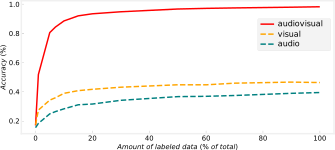] ] ] The mean of the static audiovisual latent variable $\myw{}$ is used as the input of a **linear classifier** for emotion recognition. **Only this linear classifier with 680 parameters is trained using emotion labels.** - The audiovisual approach outperforms its two unimodal counterparts by ~50% of accuracy. - With less than 10% of the labeled data, the model reaches 90% of its maximal performance. --- class: middle .grid[ .kol-2-3[ - We compare MDVAE with a SOTA method based on audiovisual transformers .small[(Chumachenko et al., 2022)]. - It uses a **strong EfficientFace backbone** for image feature extraction, pre-trained on AffectNet, the largest dataset of in-the-wild facial images labeled in emotions. <style type="text/css"> .tg {border-collapse:collapse;border-color:#ccc;border-spacing:0;} .tg td{background-color:#fff;border-color:#ccc;border-style:solid;border-width:0px;color:#333; font-family:Arial, sans-serif;font-size:16px;overflow:hidden;padding:10px 5px;word-break:normal;} .tg th{background-color:#f0f0f0;border-color:#ccc;border-style:solid;border-width:0px;color:#333; font-family:Arial, sans-serif;font-size:16px;font-weight:normal;overflow:hidden;padding:10px 5px;word-break:normal;} .tg .tg-2t70{border-color:#ffffff;font-size:16px;text-align:center;vertical-align:middle} .tg .tg-2t71{border-color:#ffffff;font-size:16px;text-align:center;vertical-align:middle} .tg .tg-y6or{border-color:#ffffff;font-size:16px;font-weight:bold;text-align:center;vertical-align:middle} </style> <table class="tg"> <thead> <tr> <th class="tg-2t70"></th> <th class="tg-2t70">Accuracy (%)</th> <th class="tg-2t70">F1 score (%)</th> </tr> </thead> <tbody> <tr> <td class="tg-2t70">Audiovisual transformer <font size="-5">(Chumachenko et al., 2022)</font></td> <td class="tg-2t71">79.2</td> <td class="tg-2t71">78.2</td> </tr> <tr> <td class="tg-2t70">Proposed approach </td> <td class="tg-y6or">79.3</td> <td class="tg-y6or">80.7</td> </tr> </tbody> </table> ] .kol-1-3[ .center.width-100[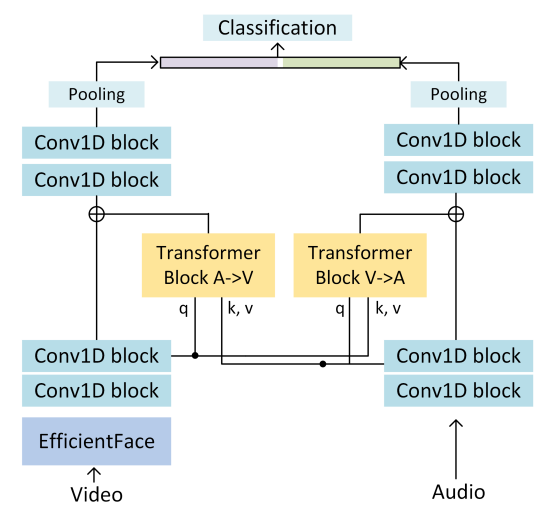] .center.small[Credits: (Chumachenko et al., 2022)] ] ] .alert[MDVAE obtains competitive results with only 680 parameters learned using emotion labels<br> ↪ **confirms the effectiveness of the learned unsupervised representation** $\myw{}$.] .credit[ K. Chumachenko et al., "Self-attention fusion for audiovisual emotion recognition with incomplete data", IEEE ICPR, 2022. ] --- class: middle, center count: false # VAE extensions for structured data --- class: middle Underlying these downstream tasks are fundamental questions concerning the **design of the VAE generative and inference models themselves**, in terms of 1. **Probabilistic modeling** ↪ *What are the probabilistic dependencies between the observed data and the latent variables of interest?* 2. **Neural architectures** ↪ *How to implement these dependencies using neural networks?* Both the probabilistic model and the neural architectures should be well aligned with the **structure of the data** .small[(spatial 2D/3D, sequential, continuous, discrete, etc.)]. --- ## VAE extensions for sequential and multimodal data .center.width-85[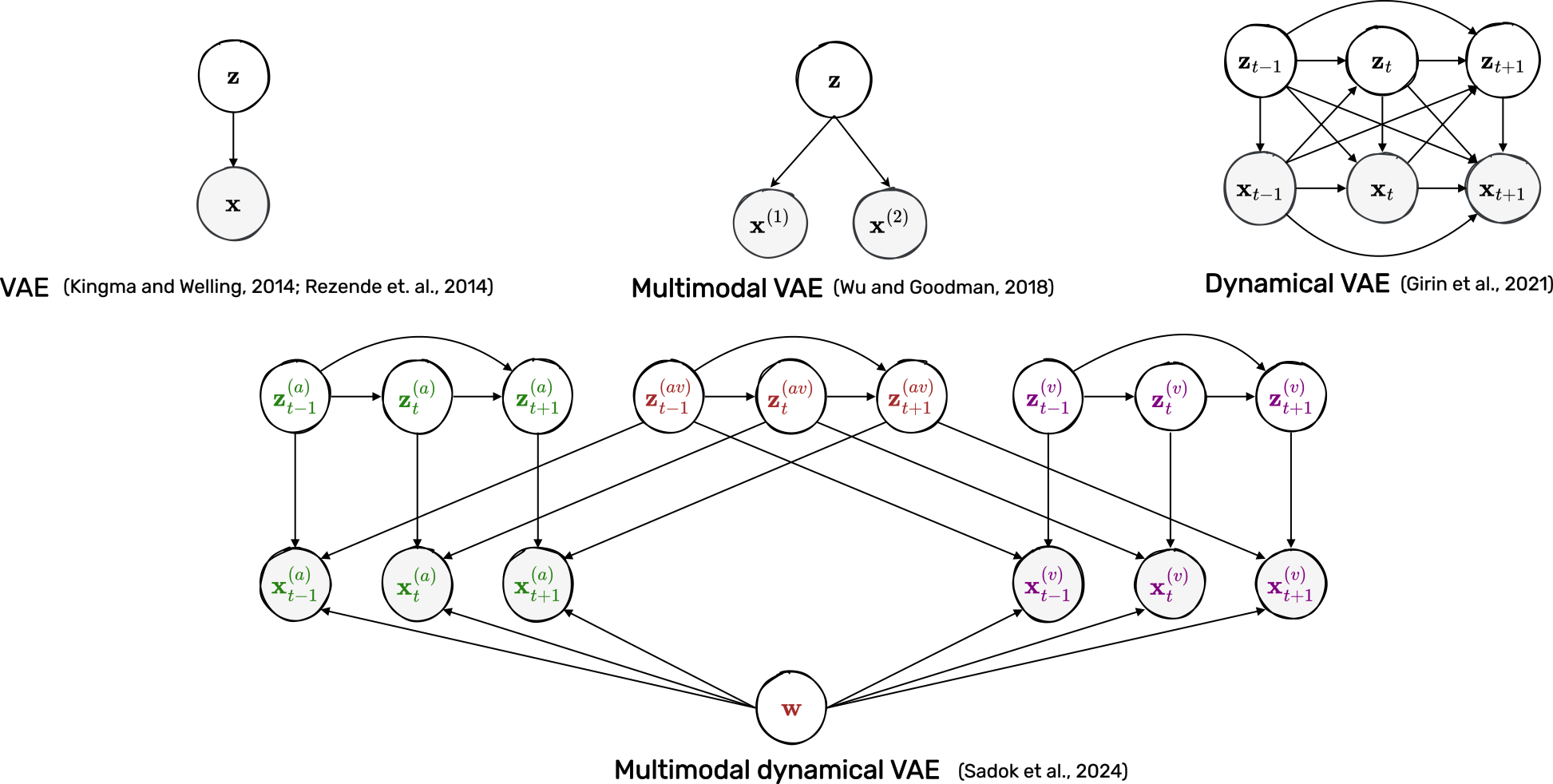] .credit[ D.P. Kingma and M. Welling (2014). Auto-encoding variational Bayes. ICLR. <br> D.J. Rezende, S. Mohamed, D. Wierstra, (2014).Stochastic backpropagation and approximate inference in deep generative models. ICML. <br> M. Wu and N. Goodman (2018). Multimodal generative models for scalable weakly-supervised learning. NeurIPS. <br> L. Girin, S. Leglaive, X. Bie, J. Diard, T. Hueber, X. Alameda-Pineda (2021). Dynamical variational autoencoders: A comprehensive review. Foundations and Trends in Machine Learning. <br> S. Sadok, S. Leglaive, L. Girin, X. Alameda-Pineda, R. Séguier (2024). A multimodal dynamical variational autoencoder for audiovisual speech representation learning. Neural Networks. ] --- class: middle ## Conclusion - Collecting labels for every scenario and tasks is intractable, we need **alternatives to supervised learning**. - **Deep generative** modeling with the **VAE** is a powerful **unsupervised** learning paradigm that can be applied to many different types of data, such as **multimodal** and **sequential data**. - We can learn **structured** and **interpretable representations** by **modeling probabilistic dependencies** between the observed data and the latent variables of interest. - One pretrained VAE can address **multiple downstream tasks**: generation, transformation, decoder-based or encoder-based. - Yes, we also process **audio signals** in the IMAGE department 😉 --- class: middle count: false .center[ # Thank you! ] --- class: middle ## VAE objective The VAE parameters are estimated by maximizing the **evidence lower bound** (ELBO) .small[(Neal and Hinton, 1999; Jordan et al. 1999)] defined by: $$\begin{aligned} \mathcal{L}(\phi, \theta) &= \underbrace{\mathbb{E}\_{q\_\phi(\myz{} | \myx{})} [\ln p\_\theta(\myx{} | \myz{})]}\_{\text{reconstruction accuracy}} - \underbrace{D\_{\text{KL}}(q\_\phi(\myz{} | \myx{}) \parallel p(\myz{}))}\_{\text{regularization}}. \end{aligned} $$ The ELBO can also be decomposed as: $$\begin{aligned} \mathcal{L}(\phi, \theta) &= \ln p\_\theta(\myx{}) - D\_{\text{KL}}(q\_\phi(\myz{} | \myx{}) \parallel p\_\theta(\myz{} | \myx{})). \end{aligned} $$ .alert[ <div style="margin-top: -0.3cm;"></div> .left-column[ .underline[Generative model parameters estimation] $$ \underset{\theta}{\max}\, \Big\\{ \mathcal{L}(\phi, \theta) \le \ln p\_\theta(\myx{}) \Big\\} $$ ] .right-column[ .underline[Inference model parameters estimation] $$ \underset{\phi}{\max}\, \mathcal{L}(\phi, \theta) \,\,\Leftrightarrow\,\, \underset{\phi}{\min}\, D\_{\text{KL}}(q\_\phi(\myz{} | \myx{}) \parallel p\_\theta(\myz{} | \myx{}))$$ ] .reset-column[ ] <div style="margin-top: -0.3cm;"></div> ] .credit[ R.M. Neal and G.E. Hinton (1999). A view of the EM algorithm that justifies incremental, sparse, and other variants. In M. I. Jordan (Ed.), .italic[Learning in graphical models]. <br> M.I. Jordan, Z. Ghahramani, T.S. Jaakkola, L.K. Saul (1999). An introduction to variational methods for graphical models. Machine Learning. 1999. ]